
In May, I made a simple argument on this blog.
Blockchain in trade credit insurance and trade finance is not a crypto story. It is a practical one: creating a trusted digital record for receivables, so that banks can finance them faster and with more confidence. I said the infrastructure was moving from the experimental phase into the regulated financial system, and that whoever built the trusted digital layer first would gain a meaningful advantage.
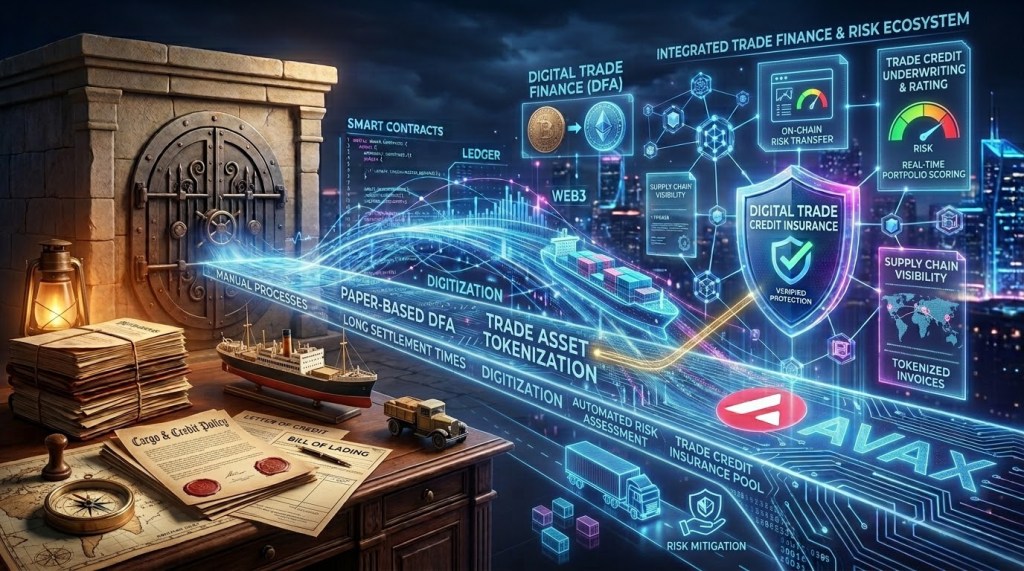
This month, it happened.
On 25 August 2026, POSCO International America Corp., together with Olea and Intain, completed what they called a landmark on-chain trade finance transaction. Trade receivables were converted into tokenised digital assets and recorded on-chain. Intain’s platform first reconciled the data across invoices, purchase orders, credit notes and shipment documents. The assets were then verified and registered on a Layer 1 network on the Avalanche blockchain, and integrated into existing trade finance workflows.
So: was I right?
On the diagnosis, mostly yes. But there is one honest correction to make, and it matters more than the confirmation.
What the transaction confirms
My core thesis held up almost word for word.
I argued that the value of blockchain here is not turning invoices into crypto assets. It is turning uncertain documents into verifiable digital records. Intain’s founder framed the same deal as AI establishing the truth of the asset, and blockchain preserving that truth and connecting it to financing. Same idea, different words.
I argued for a specific sequence: verify the receivable first, then finance it. Intain’s own summary was blunter than mine. “Tokenize the asset first, then the financing.” Same sequence.
And I said the reconciliation problem (the emails, PDFs, ERP exports and manual checks) was the real friction. That is exactly what Intain’s platform automated before anything touched the chain. Olea’s CEO described the deal as a move from proof-of-concept to real-world adoption, which is the transition I said was underway.
The direction, the mechanism and the timing were correct.
The correction I owe the argument
My first instinct, reading the announcement, was to say the transaction had no credit insurer in it.
That was too confident. The honest truth is: I don’t know. And that uncertainty is the point.
Olea is a Singapore-based trade finance origination and distribution platform, incubated by SC Ventures (Standard Chartered’s innovation and ventures arm), with Linklogis as its other shareholder. Platforms that distribute trade finance assets to institutional funders very often sit on credit insurance or guarantees, not on the individual invoice but behind the funding, protecting the investors who buy the assets. It is entirely possible that credit insurance stands behind this transaction. I simply cannot see it. Neither can the financing bank. Neither can the token.
That is the real state of our market today. Where credit insurance exists in these structures, it usually sits off-chain, behind the platform, invisible to the very asset it is protecting.
Which reframes the question this post is really about. Not “is the insurer in the room?” but “where should the insurer sit, behind the chain, or on it?”
Two places credit insurance can sit
Behind the chain: where it mostly sits today. Insurance wraps the platform, the funding vehicle or the portfolio. The insurer covers a funder against buyer default across a book of assets. It is real, and it is valuable. But it is generic and invisible. It does not travel with the individual tokenised receivable. A bank looking at a single token cannot confirm it. And the insurer captures neither the data nor the direct relationship. In this position, the insurer is balance sheet, and not much more.
On the chain: where it could sit tomorrow. Cover confirmation becomes a data object attached to the tokenised receivable itself. For a specific token, an authorised party can confirm, in real time:
- this asset is covered under a valid policy,
- the buyer limit is available,
- the policyholder is compliant with policy obligations,
- the claim route survives the assignment.
Insurance stops being a background wrap and becomes a property of the asset.
The difference is not cosmetic. An uninsured tokenised receivable is verified but still exposed to buyer default. A tokenised receivable that carries live confirmation of valid cover is a different, more bankable asset, and the insurer that confirms it is part of the infrastructure, not hidden behind it.
Why this matters beyond insurance: the double-selling problem
Step back from insurance for a moment, because the bigger prize here is not ours alone.
For factoring companies, trade finance banks, supply chain finance providers and the corporates who use them, one risk has never been fully solved: the same receivable, or the same underlying goods, being financed more than once.
Double selling. Multiple financing. Same invoice, two funders. A supplier assigns a receivable to Factor A, then assigns the same receivable to Bank B, which cannot see that it is already gone. It is one of the oldest fraud vectors in trade finance. The 2014 Qingdao metals scandal, where the same metal was pledged to multiple banks against duplicate warehouse receipts and left international lenders more than a billion dollars out of pocket, is the textbook case. But the pattern recurs across commodity trade finance and receivables finance alike, precisely because there is no shared record to catch it: the same asset pledged in more than one place, often in more than one jurisdiction.
Today the defences are fragmented. Notification of assignment. Local receivables registries in some countries and none in others. Audits. Trust. Across borders it is weaker still. There is no single, shared source of truth that tells every funder, in real time, whether a receivable is still available. The industry knows it: the ITFA has a working group on exactly this, and a small industry of invoice-duplication checks has grown up around the gap.
That gap is what an on-chain registry closes.
When a receivable is tokenised and its assignment status lives on a shared ledger, “already financed” becomes visible to everyone entitled to see it. Factor A finances it; the asset is marked; Bank B checks and sees it is taken. The same receivable cannot be sold twice, because being sold once is now a fact on a record that no single party controls and no single party can quietly alter.
This is the point I made in May about double financing, but it is far larger than credit insurance. It is the strongest practical reason for every classic trade finance and factoring player to look at this technology now, not in five years.
Why “later” is the dangerous answer
Here is the uncomfortable part for incumbents.
The rail that solves double-selling does not have to be built by the banks and factoring companies that suffer from the problem. It is being built right now, by trade finance platforms, by tokenisation infrastructure providers, by players who did not exist a decade ago.
Whoever builds the registry owns the standard, the data and the client relationship.
If the incumbents wait, they do not simply delay a benefit. They risk waking up in a market where a new layer of providers sits between them and their clients, where the factoring company, the financing bank, or the credit insurer has become interchangeable capacity behind someone else’s rail, while the valuable position, the trusted digital record, belongs to a platform that moved first.
That is how established players get left behind. Not in one dramatic disruption, but by treating the infrastructure as someone else’s problem until the infrastructure is already owned. For credit insurers specifically, the risk is the quiet version of it: not being removed, but being relegated, pushed behind the chain, commoditised, and kept away from the data and the relationship that make the business defensible in the first place.
What to do now
Three moves follow. They are written for insurers, but the logic applies just as much to factoring companies and financing banks.
First, treat your data as infrastructure, not paperwork. For an insurer, that is limit availability, cover percentage, compliance status and claim eligibility. For a factor or a bank, it is assignment and financing status. These are the exact data points a digital receivables rail is built on. Expose them in a structured, confirmable form and you are in the plumbing. Keep them locked in PDFs and emailed confirmations, and you get routed around.
Second, engage the platforms directly. The Oleas and Intains of this market are building the rails now, and the early transactions are where the conventions get set: the format of a digital confirmation, the assignment rules, how a claim survives tokenisation. Being in the room while they are written is worth more than reacting to them later.
Third, decide whether to be a participant or a definer. This is the point I would put to my own side of the market, the brokers. The broker’s role here shifts from placing cover to orchestrating the confirmation layer: connecting insurer, platform and funder, and making sure the digital cover confirmation is trusted and standard. For whoever moves early, that is a larger role than placement, not a smaller one.
One more thing: why this is being built on Avalanche
The POSCO, Olea and Intain transaction was executed on a Layer 1 network on Avalanche. That choice is not incidental, and it is worth a plain-language word for readers who do not follow blockchain closely, because it explains why this technology is finally becoming usable for regulated finance.
I have followed Avalanche’s development closely, and in my view it has one of the strongest chances of genuine institutional adoption. Here is why, without the jargon.
Most people picture a blockchain as one giant public network where anyone can do anything, which is exactly what makes a compliance officer nervous. Avalanche works differently. It lets an institution run its own chain, with its own rules, while still connecting to the wider network. Avalanche calls these compliance-ready networks “Evergreen” L1s.
For regulated finance, that solves the problem that kept banks away for years. On such a chain:
- only approved, identity-verified parties can take part, with KYC and KYB enforced by the network itself rather than bolted on afterwards,
- access can be restricted by jurisdiction, so the chain respects where its participants are allowed to operate,
- transactions settle and become final in seconds, which matters when you are moving real money,
- and it stays interoperable. A compliant chain is not an isolated island; it can still connect to the broader ecosystem.
In other words, you get the shared, tamper-resistant record that makes double-selling impossible, without giving up the compliance controls that regulated institutions are required to have. That combination of control and connection is the hard part, and it is what this architecture was built for.
It is not theory. Global banks and asset managers have already used this kind of infrastructure: JPMorgan ran tokenisation pilots on a permissioned Avalanche network, and Franklin Templeton added Avalanche to its on-chain money-market fund. The POSCO transaction is simply one of the first to bring trade receivables onto it. When the compliance problem is solved at the level of the rail itself, the barrier to adoption drops, and that is why deals like this one are starting to happen for real.
The updated bottom line
In May I ended with a triad. It still holds:
Trade credit insurance protects the receivable.
Trade finance monetises the receivable.
Blockchain can verify the receivable.
The August transaction proved the third line is real. The open question is where everyone else sits when it becomes the norm. Behind the chain (invisible, generic and commoditised), or on it (confirmable and part of the infrastructure).
For credit insurers, factoring companies and trade finance banks alike, the technology will not make that choice. We will, by moving now, or by discovering, a few deals from now, that the seat was designed without us.
I would rather we sat on the chain.

